
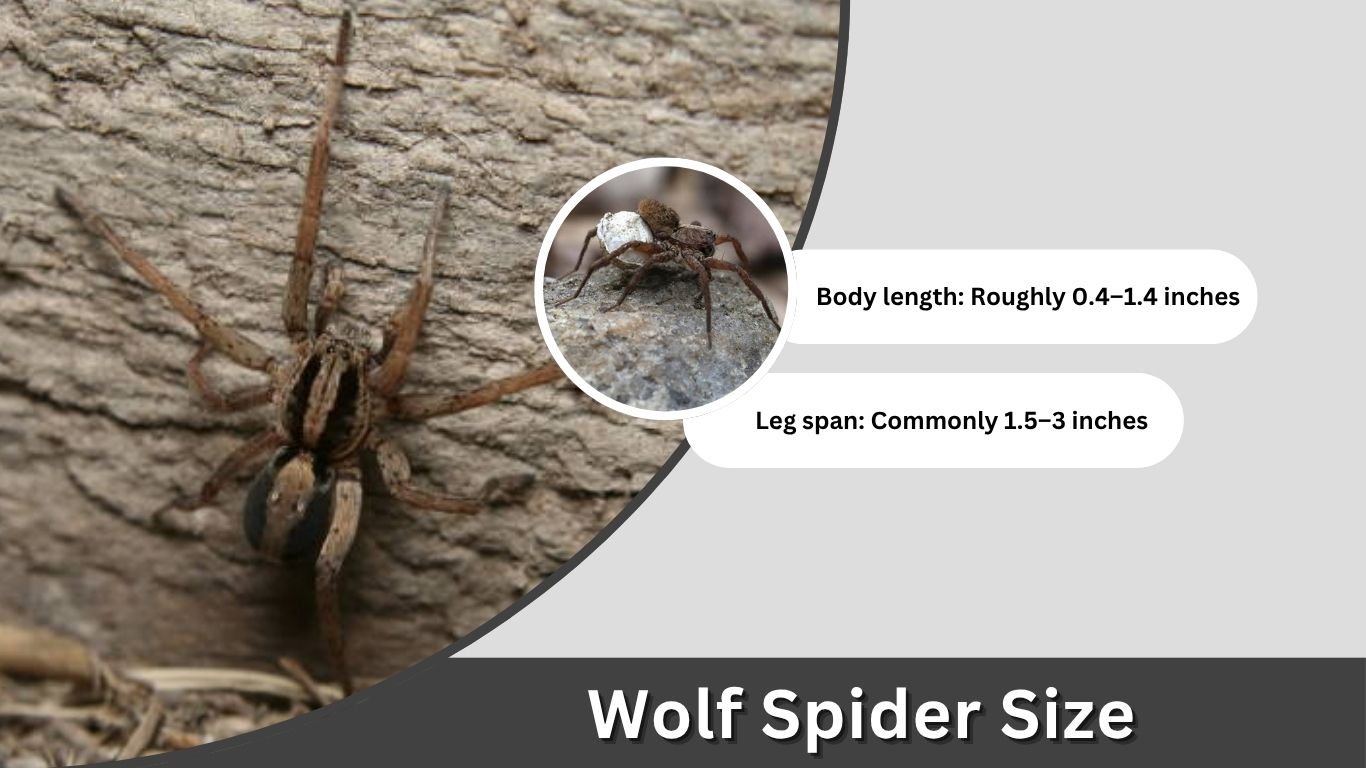
Wolf spider size varies greatly because the family Lycosidae contains thousands of species ranging from tiny ground hunters to large, heavy-bodied spiders. Many common wolf spiders have a body length of around 0.4 to 1 inch, while larger species can exceed 1 inch before the legs are included. Their long, sturdy legs often make them appear much bigger than their actual body size. Carolina wolf spiders are among the largest commonly encountered species in North America. This guide explains average wolf spider size, full-grown measurements, giant species, males vs. females, and comparisons with other large spiders.
How Big Is a Wolf Spider?
Wolf spiders come in a wide range of sizes. Some species are small enough to go unnoticed in grass or leaf litter, while larger adults can look surprisingly big when running across a floor or patio. Measuring only the body gives a more accurate scientific comparison, while leg span better represents how large the spider appears to a person.
Wolf Spider Size Chart
Typical size ranges include:
| Wolf Spider Type | Approximate Body Length |
| Small wolf spider | 0.2–0.4 inch |
| Average wolf spider | 0.4–1 inch |
| Large wolf spider | 1–1.4 inches |
| Carolina wolf spider | Up to around 1.4 inches |
| Very large species | May exceed 1.4 inches |
Leg span can make larger wolf spiders appear around 2 to 4 inches across, depending on the species and individual.
Average Wolf Spider Size
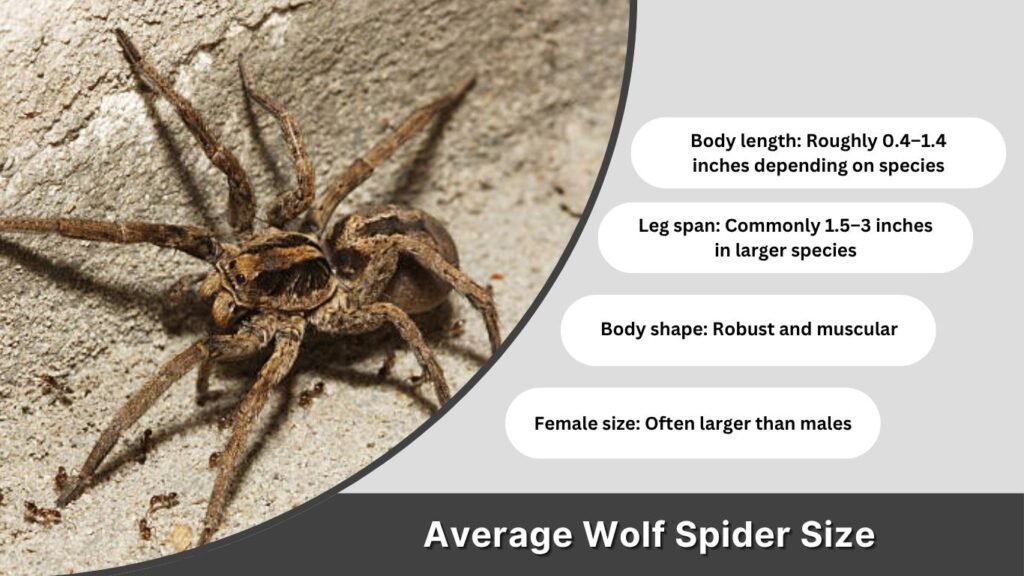
An average wolf spider is usually much smaller than its intimidating appearance suggests. Hairy legs, a broad body, and fast movement can make a one-inch spider seem considerably larger.
Females are often larger and heavier-bodied than males because they need more space and energy for egg production.
Full-Grown Wolf Spider Size
A full-grown wolf spider may have:
- Body length: Roughly 0.4–1.4 inches depending on species
- Leg span: Commonly 1.5–3 inches in larger species
- Body shape: Robust and muscular
- Female size: Often larger than males
- Male size: Usually slimmer with proportionally longer legs
Some unusually large individuals may appear even bigger when their legs are fully extended.
Carolina Wolf Spider Size
The Carolina wolf spider (Hogna carolinensis) is among the largest wolf spiders in North America. Its large body, long legs, and gray-brown coloration make it especially noticeable when encountered at night or around buildings.
How Big Is a Carolina Wolf Spider?
Large females can reach approximately 1 to 1.4 inches in body length, not including the legs.
With legs extended, a mature Carolina wolf spider may appear several inches across.
Females typically have more robust abdomens, while males may look slimmer and somewhat leggier.
Giant Wolf Spider Size
The phrase “giant wolf spider” can refer to unusually large wolf spider species rather than one universal species.
Some of the largest wolf spiders occur in warm regions and on islands where individual species have evolved larger body sizes.
How Large Can Giant Wolf Spiders Get?
Large wolf spiders may exceed an inch in body length, with leg spans several times longer.
The impressive appearance comes from:
- Long legs
- Thick hair
- Broad cephalothorax
- Large abdomen
- Strong running posture
Even so, most wolf spiders remain much smaller than the largest tarantulas or huntsman spiders.
Rabid Wolf Spider Size
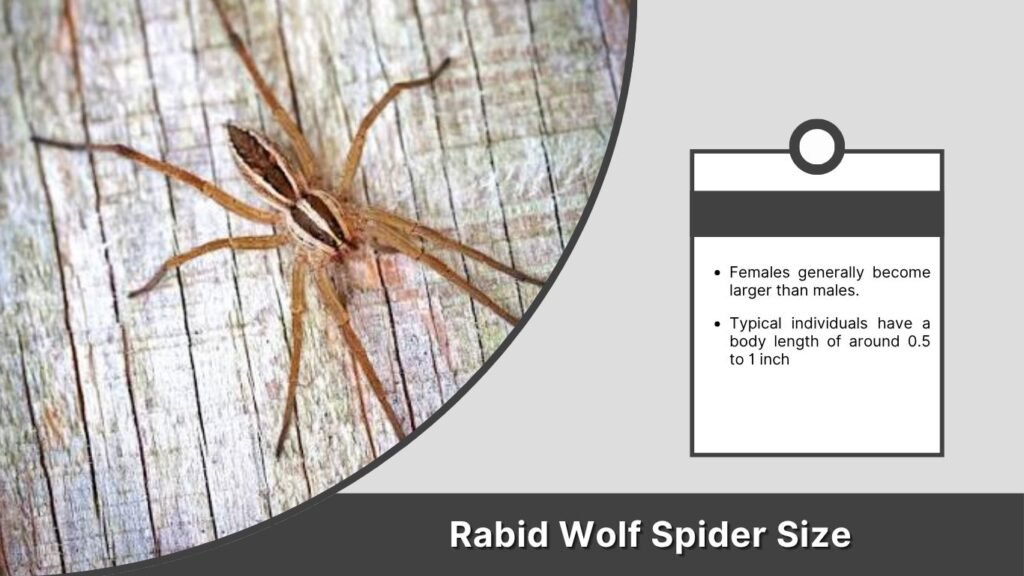
The rabid wolf spider (Rabidosa rabida) is a common North American species. Despite its alarming common name, “rabid” does not mean the spider carries rabies.
It is a medium to large wolf spider with noticeable longitudinal stripes.
Adult Rabid Wolf Spider Size
Females generally become larger than males.
Typical individuals have a body length of around 0.5 to 1 inch, with the legs making the spider look considerably larger.
The species is often recognized by contrasting stripes running along the body.
Texas Wolf Spider Size
Texas is home to many wolf spider species, so there is no single “Texas wolf spider size.”
Both small and large species occur throughout the state.
Large Wolf Spiders in Texas
Large species, including Carolina wolf spiders and members of related genera, may reach around an inch or more in body length.
In warm climates, wolf spiders may be encountered around:
- Lawns
- Gardens
- Fields
- Garages
- Patios
- Wooded areas
Their apparent size often becomes more dramatic when seen indoors.
Florida Wolf Spider Size
Florida also supports numerous wolf spider species.
Some are relatively small, while large species can have bodies near or above one inch and leg spans of several inches.
Why Florida Wolf Spiders Look Large
Warm conditions and abundant insect prey support a diverse wolf spider population.
Large adults may look especially impressive because of their:
- Thick legs
- Hairy bodies
- Fast movement
- Wide running posture
The biggest individuals are usually mature females.
Michigan Wolf Spider Size
Wolf spiders found in Michigan generally range from small species to relatively large adults approaching an inch or more in body length.
Large wolf spiders may be noticed around basements, garages, gardens, and wooded areas.
Michigan Wolf Spider Appearance
Their size varies according to species rather than location alone.
A spider found in Michigan may therefore be considerably smaller or larger than another wolf spider from the same state.
Australian Wolf Spider Size
Australia has many wolf spider species with substantial variation in size.
Some are small ground-dwelling hunters, while others have robust bodies and relatively broad leg spans.
How Big Are Australian Wolf Spiders?
Large Australian wolf spiders can reach approximately an inch or more in body length, depending on species.
They are sometimes confused with huntsman spiders, which often have a wider leg span and more sideways-oriented legs.
Male vs. Female Wolf Spider Size
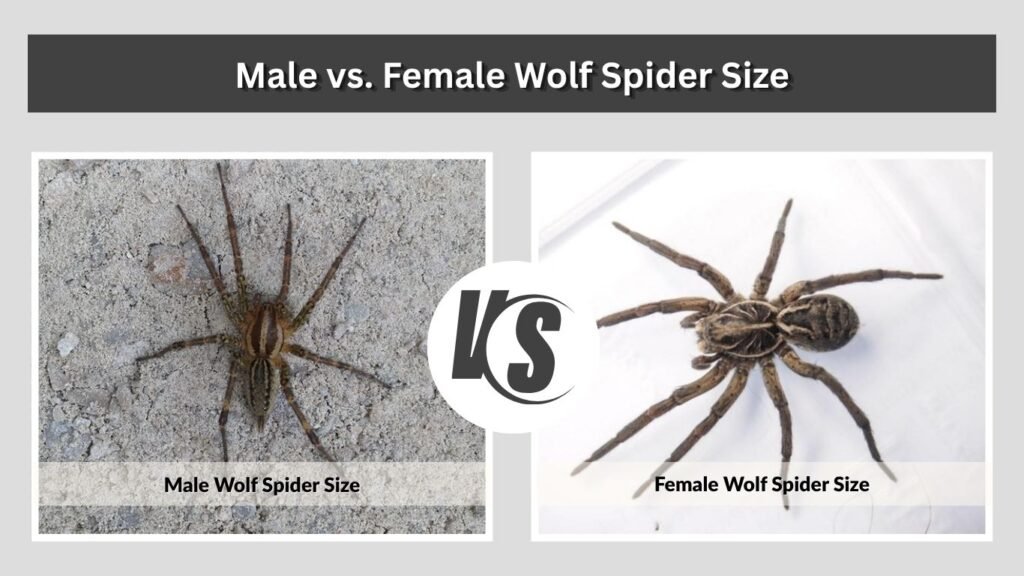
Sex can make a noticeable difference in wolf spider appearance.
Females are generally bulkier, especially when carrying eggs or spiderlings.
Female Wolf Spider Size
Female wolf spiders commonly have:
- Larger abdomen
- Heavier body
- Greater overall mass
- More robust appearance
A female carrying an egg sac may look especially large from behind.
Male Wolf Spider Size
Males are often:
- Slimmer
- Lighter-bodied
- Longer-legged relative to body size
- More mobile during mating season
Although a male may have a wide leg span, his body is frequently smaller than that of a mature female.
Wolf Spider Size Compared to a Hand
Most wolf spiders are nowhere near the size of an adult human hand, although photos can create that impression.
A large wolf spider with extended legs might cover part of the palm or several fingers, but the body itself is usually only around an inch long.
Why Do They Look So Big?
Wolf spiders appear larger because:
- Legs extend far beyond the body
- Hair increases apparent thickness
- Fast movement exaggerates size
- Indoor encounters provide close perspective
- Shadows can make leg span look wider
A photo without a scale reference can therefore be misleading.
Wolf Spider vs. Tarantula Size
Tarantulas are generally much larger and heavier than wolf spiders.
Some wolf spiders may superficially resemble small tarantulas because both can be hairy and robust.
Size Comparison
| Feature | Wolf Spider | Tarantula |
| Body size | Usually under 1.5 inches | Often substantially larger |
| Leg span | Commonly 1–4 inches | May reach several inches |
| Build | Athletic and fast | Thick and heavy |
| Hair | Hairy | Usually very hairy |
| Weight | Light | Much heavier |
A large wolf spider can look formidable, but most true tarantulas outweigh it considerably.
Fishing Spider vs. Wolf Spider Size
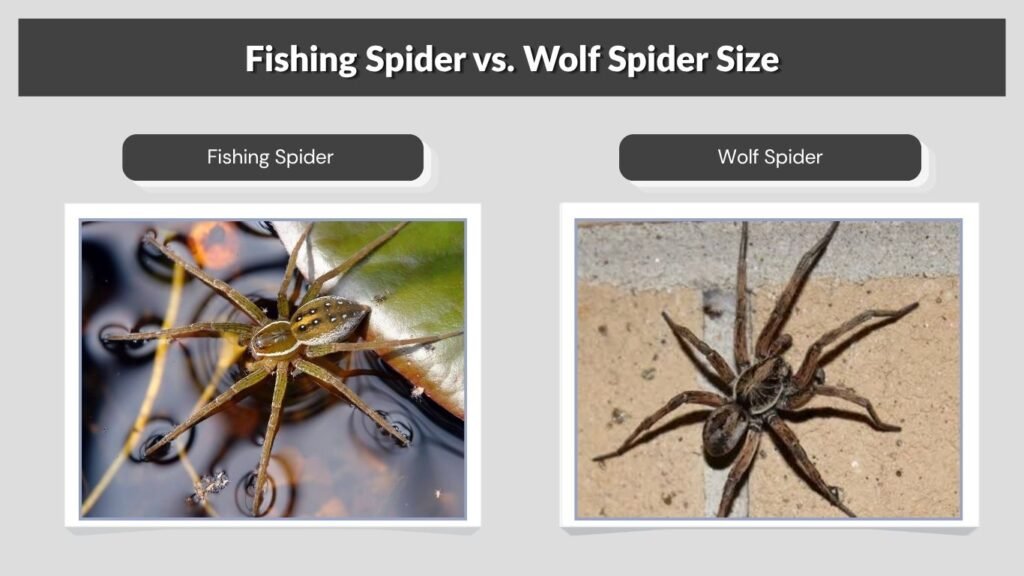
Fishing spiders are another group frequently confused with wolf spiders.
Some fishing spiders have longer legs and a larger overall span than most wolf spiders.
Main Size Difference
Fishing spiders often look wider because their legs extend farther from the body.
Wolf spiders generally have:
- More compact bodies
- Stockier legs
- Ground-running posture
Fishing spiders often appear flatter and more spread out.
Huntsman Spider vs. Wolf Spider Size
Huntsman spiders are famous for their exceptionally wide leg span.
Even when body length is similar, huntsman spiders can look dramatically larger than wolf spiders.
Huntsman vs. Wolf Spider
Huntsman spiders typically have:
- Longer legs
- Sideways-oriented leg posture
- Flatter bodies
- Much wider apparent span
Wolf spiders are usually more compact and built for rapid ground pursuit.
Grass Spider vs. Wolf Spider Size
Grass spiders and wolf spiders are often similar in overall size.
Grass spiders usually have longer-looking legs and more slender bodies.
How to Tell Them Apart
Grass spiders typically:
- Build funnel webs
- Have long spinnerets
- Look somewhat slimmer
Wolf spiders:
- Hunt without prey-catching webs
- Look heavier and hairier
- Have two large central eyes
Size alone is not enough for reliable identification.
Brown Recluse vs. Wolf Spider Size
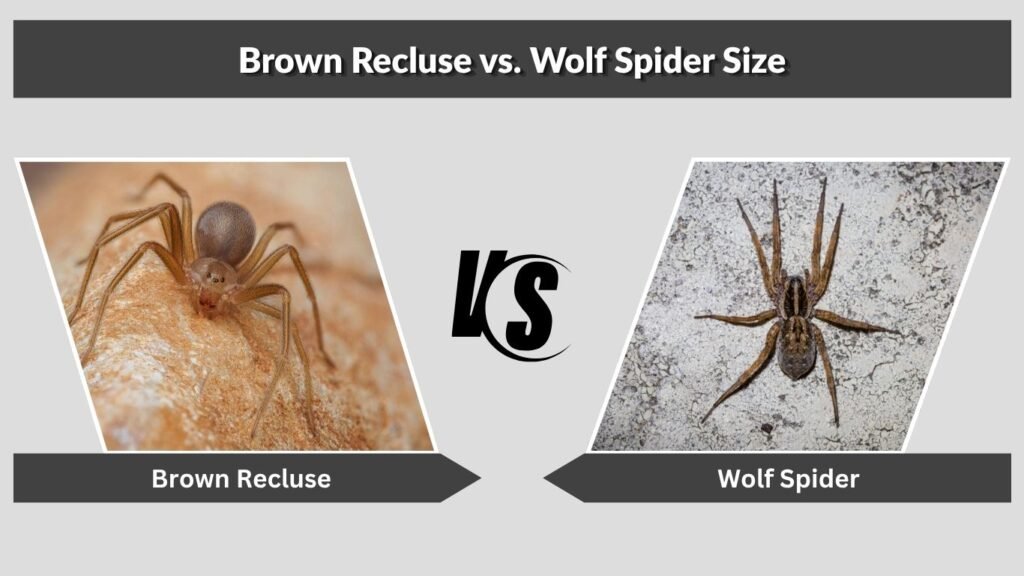
Brown recluse spiders generally have smaller, slimmer bodies than large wolf spiders.
Wolf spiders frequently appear much larger because of their thick legs and robust build.
Size and Appearance Difference
A brown recluse usually has:
- Slender legs
- Relatively plain brown body
- Less hair
- Smaller overall bulk
A wolf spider commonly has heavier legs, strong striping or mottling, and a significantly stockier appearance.
House Wolf Spider Size
A wolf spider found indoors may appear enormous because it is seen against flat floors or walls.
However, indoor wolf spiders are not a special oversized type.
Why Big Wolf Spiders Enter Houses
Large adults may wander indoors while:
- Hunting insects
- Seeking shelter
- Moving during mating season
- Following openings around doors
- Escaping changing outdoor conditions
A large spider indoors is usually an accidental visitor rather than evidence that wolf spiders are growing unusually large inside the house.
Wolf Spider Egg Sac Size
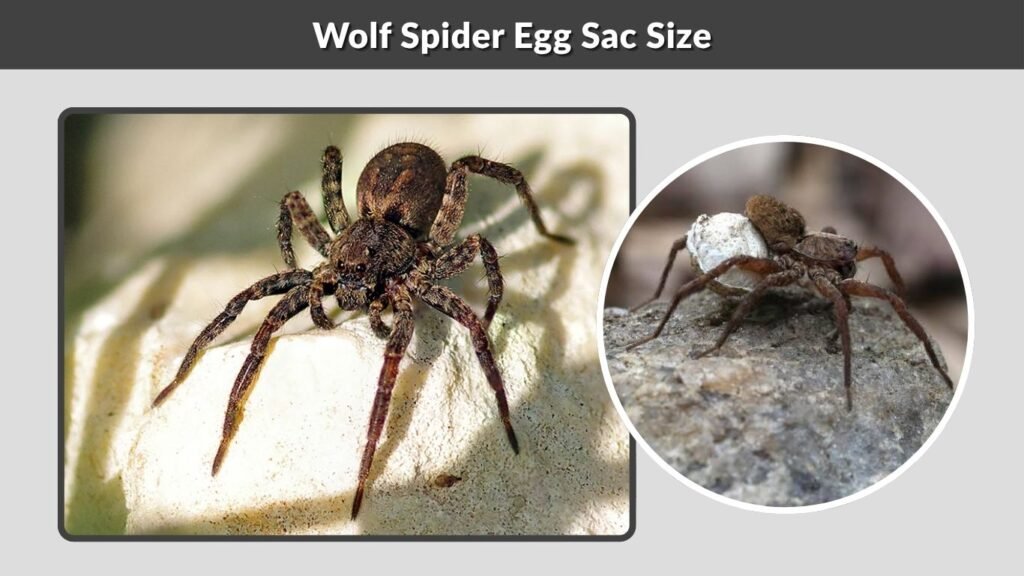
Female wolf spiders carry their egg sacs attached to the spinnerets at the rear of the abdomen.
The sac appears as a rounded ball and can make the female look significantly larger.
Female With Spiderlings
After the eggs hatch, the spiderlings climb onto their mother’s abdomen and back.
A female carrying dozens of young may appear much bulkier and more textured than an ordinary adult.
This maternal behavior is one of the most distinctive characteristics of wolf spiders.
FAQs
What Is the Average Size of a Wolf Spider?
Many common wolf spiders have body lengths between roughly 0.4 and 1 inch. Smaller species can be considerably shorter, while large adults may exceed an inch. Their leg span often makes them appear two or three times larger than their actual body length.
What Is the Biggest Wolf Spider Size?
Some of the largest wolf spiders have bodies exceeding 1 inch, with exceptionally large species approaching around 1.5 inches or more. Their total leg span can reach several inches, although exact maximum size depends on the species.
How Big Is a Carolina Wolf Spider?
A large female Carolina wolf spider can reach approximately 1 to 1.4 inches in body length. Including the legs, mature individuals may appear several inches across, making them among the largest commonly encountered wolf spiders in North America.
Are Wolf Spiders Bigger Than Tarantulas?
Generally, no. Tarantulas usually have heavier bodies and substantially larger leg spans. Large wolf spiders can resemble small tarantulas, but most full-grown tarantulas are considerably bigger and heavier than wolf spiders.
Are Female Wolf Spiders Bigger Than Males?
Females are generally larger and more robust than males. Their abdomens are especially large when producing eggs. Males tend to have slimmer bodies and may look longer-legged, but females usually have greater body mass and overall bulk.
