
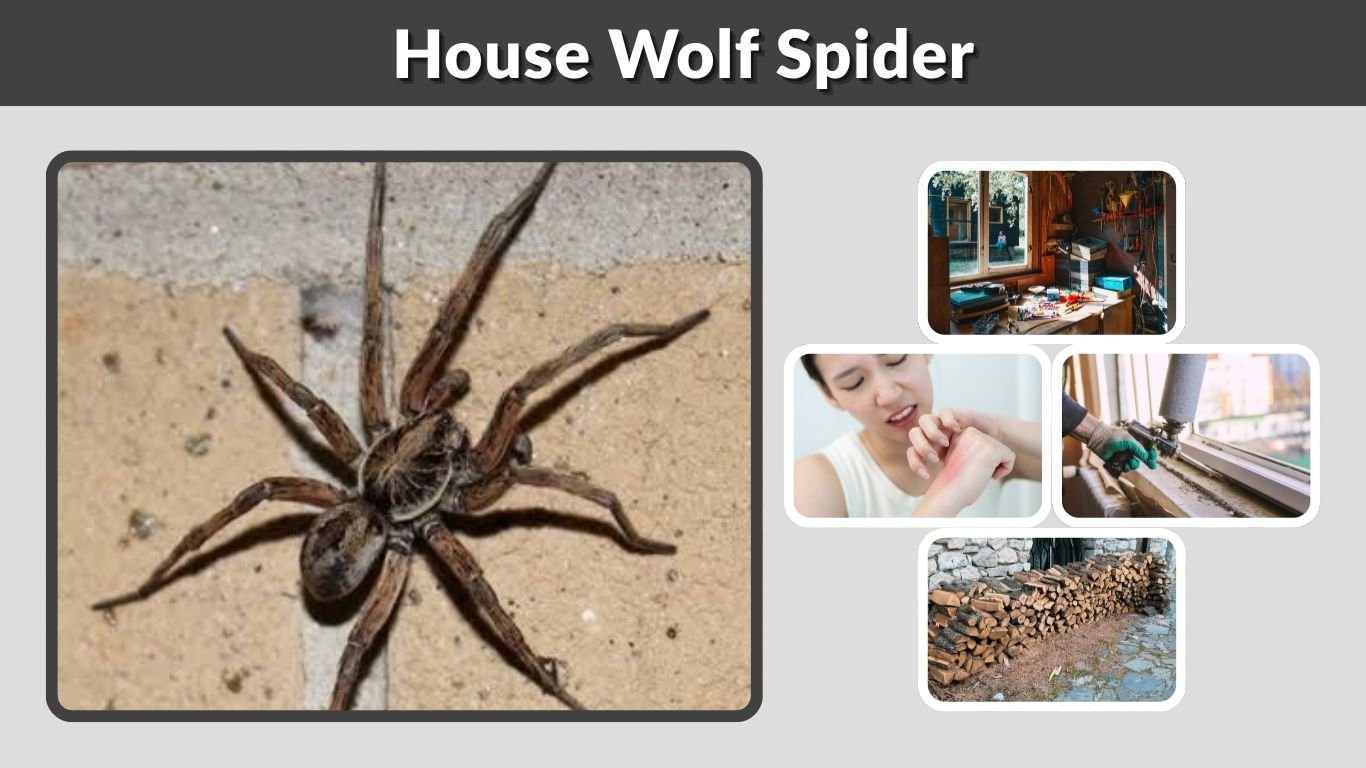
A house wolf spider is not a separate species but usually refers to a wolf spider that has wandered indoors. Wolf spiders belong to the family Lycosidae and are active hunters rather than web-building spiders. They are commonly brown, gray, or black with striped or mottled markings and strong legs built for running. Finding a large wolf spider in your house can be startling, but these spiders generally avoid people and are not considered dangerously venomous to humans. This guide covers identification, bites, size, look-alikes, and how to safely remove wolf spiders from your home.
What Is a House Wolf Spider?
Wolf spiders are ground-hunting spiders that normally live outdoors in gardens, grasslands, woodland edges, leaf litter, and other sheltered places. They sometimes enter houses while searching for insects, warmth, moisture, or protected hiding spaces. Because there are many wolf spider species, their exact color, pattern, and size can vary significantly.
House Wolf Spider Identification
Look for these common features:
- Brown, gray, tan, or nearly black coloration
- Hairy or fuzzy-looking body
- Thick, powerful legs
- Longitudinal stripes or mottled markings
- Robust rather than delicate body shape
- Excellent running ability
- Eight eyes arranged in three rows
- Two especially large forward-facing eyes
- Usually found walking rather than sitting in a web
Their large central eyes are one of the best clues for identifying a true wolf spider.
Why Is There a Wolf Spider in My House?
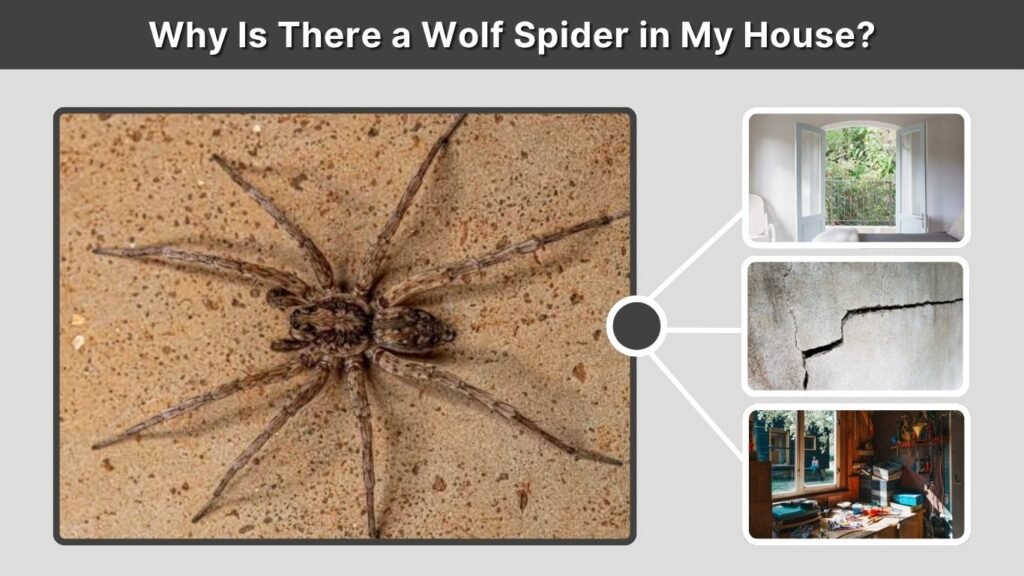
A wolf spider inside the house usually entered accidentally. These spiders are not typically trying to establish themselves beside people. They often follow prey through small openings or move indoors when outdoor conditions become less favorable.
Why Wolf Spiders Come Indoors
Possible reasons include:
- Abundant insects indoors
- Cool or changing weather
- Open doors or windows
- Cracks around foundations
- Gaps beneath doors
- Moist basements
- Garages and sheds
- Boxes or firewood brought inside
Seeing one wolf spider does not necessarily mean you have an infestation.
What Does a Wolf Spider Look Like in the House?
Indoors, wolf spiders may appear dark because of low lighting. Their thick legs and fast movement often make them seem larger than they really are.
They are commonly found along floors, walls, baseboards, garages, basements, bathrooms, or areas where insects are available.
Black House Wolf Spider
Some wolf spider species can appear very dark brown or almost black. Their bodies may still show faint stripes or patterns when viewed closely.
A completely dark spider found inside should not automatically be identified as a wolf spider. Black house spiders, fishing spiders, funnel weavers, and other species can sometimes look similar.
House Wolf Spider Size
Wolf spiders range considerably in size. Some are relatively small, while larger species can look impressive when their legs are included.
How Big Can a House Wolf Spider Get?
Depending on species:
- Small species may have bodies under 1/2 inch long.
- Medium wolf spiders may have bodies around 1/2 to 1 inch.
- Larger species may approach or exceed 1 inch in body length.
- Leg span can make a large individual appear several inches across.
Females are often more robust than males, particularly when carrying eggs.
Small Wolf Spider in the House
Young wolf spiders and naturally small species can be much less noticeable than large adults.
Baby wolf spiders have the same general body plan as adults but are much smaller.
Baby Wolf Spider Behavior
One fascinating feature of wolf spiders is maternal care. A female carries her egg sac attached behind her abdomen. When the spiderlings hatch, they climb onto their mother’s back and remain there temporarily.
A female covered with young can therefore look unusually bumpy or textured.
House Spider vs. Wolf Spider
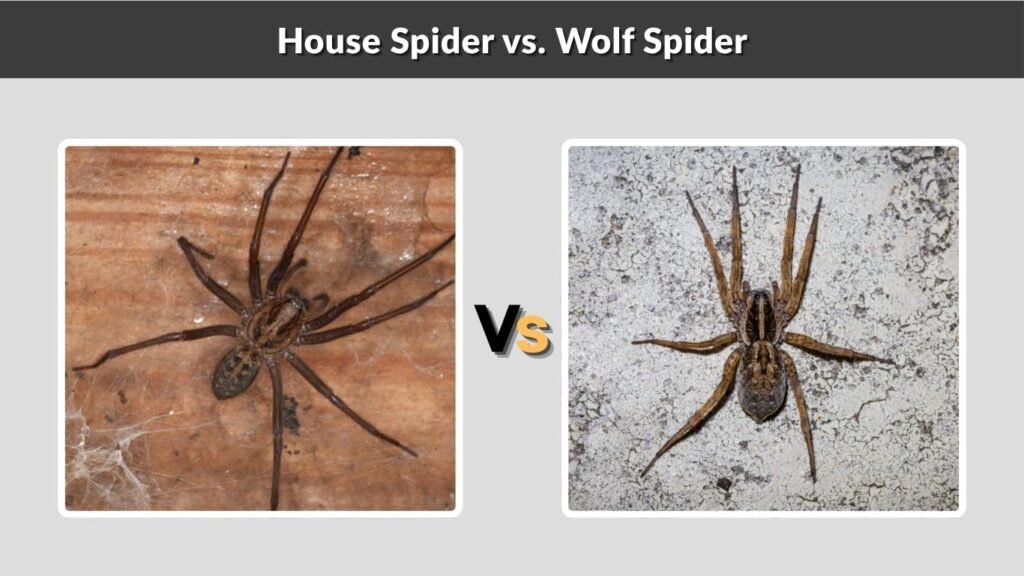
Wolf spiders are often confused with ordinary house spiders, but their behavior provides useful clues.
Wolf spiders actively hunt prey, while many common house spiders rely on webs to catch insects.
Main Differences
| Feature | Wolf Spider | Common House Spider |
| Hunting | Actively runs after prey | Usually catches prey in web |
| Body | Robust and hairy | Often smaller and rounder |
| Legs | Strong and powerful | Usually thinner |
| Web | Does not use prey-catching web | Builds irregular web |
| Eyes | Two large prominent eyes | Less obvious eye arrangement |
| Movement | Fast ground runner | Often stays near web |
Finding a spider repeatedly sitting in a messy web makes a wolf spider identification less likely.
Giant House Spider vs. Wolf Spider
Giant house spiders and wolf spiders can both be large, brown, and fast-moving.
However, giant house spiders belong to the funnel-weaver group and commonly construct funnel-shaped webs.
How to Tell Them Apart
A giant house spider usually has longer, more slender legs relative to its body and may be associated with a funnel web.
Wolf spiders are generally more compact, hairy, and strongly built. They spend much of their time roaming across the ground rather than remaining in a web.
Black House Spider vs. Wolf Spider
The black house spider is another species that can be confused with dark wolf spiders, particularly in regions such as Australia.
Black house spiders tend to live around their webs, while wolf spiders are mobile hunters.
Key Difference
A spider living consistently inside a messy or funnel-like web around a window, wall crevice, or sheltered corner is less likely to be a wolf spider.
A stocky spider running quickly across the floor without an obvious web is more consistent with wolf spider behavior.
Wolf Spider vs. Brown Recluse
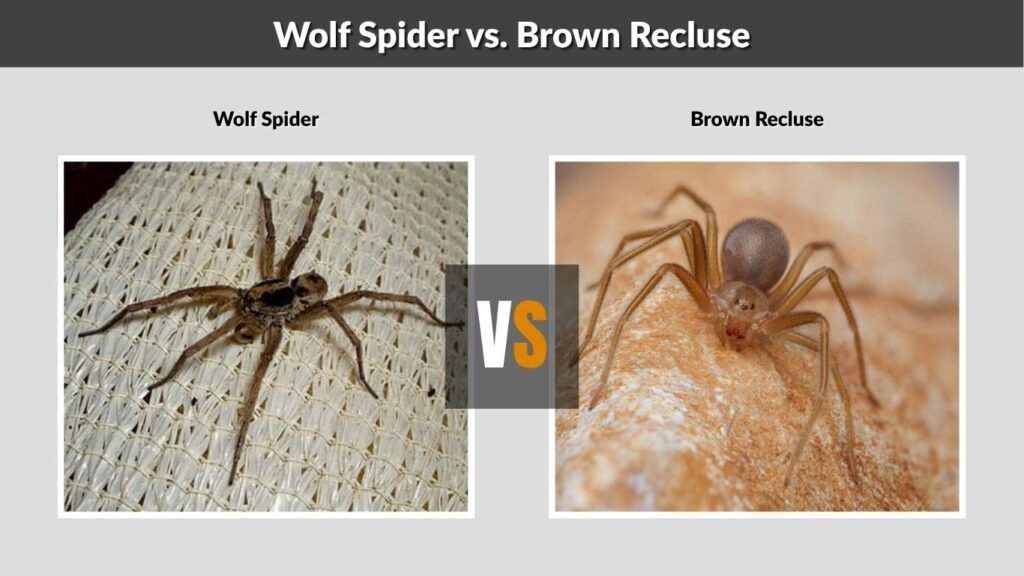
Brown recluse spiders and wolf spiders are sometimes confused because both may be brown, but they have several important differences.
Wolf spiders generally have more obvious patterns and hairy, robust bodies.
Main Differences
Brown recluse spiders typically have:
- Relatively uniform brown coloration
- Slender legs
- Six eyes arranged in three pairs
- A violin-like marking on the upper body in typical adults
Wolf spiders generally have:
- Eight eyes
- Two very large central eyes
- Hairier bodies
- More obvious stripes or mottled markings
- A stronger, stockier appearance
Do not rely on a single marking when identifying a potentially medically important spider.
House Wolf Spider Bite
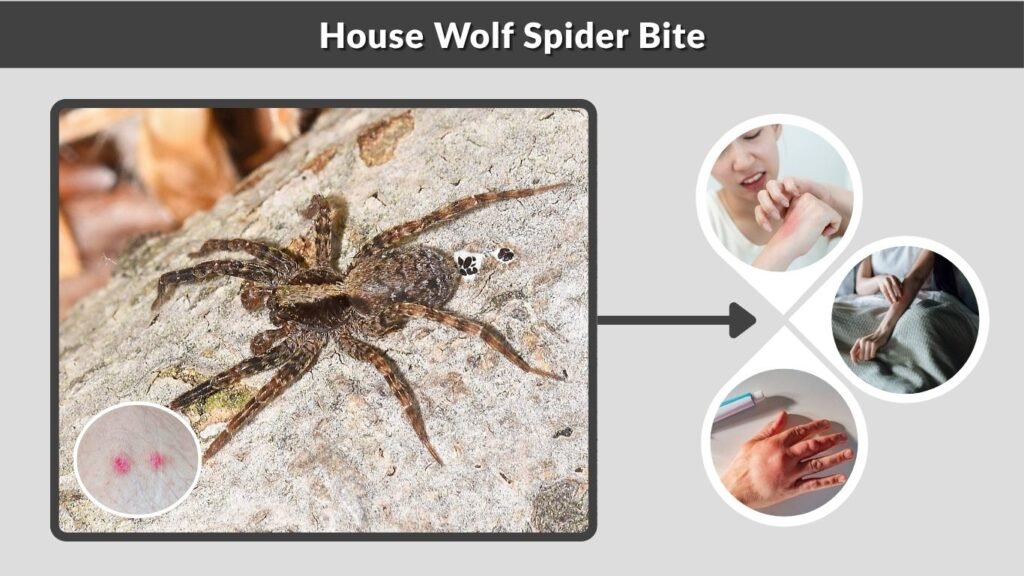
Wolf spiders can bite if trapped against the skin or handled roughly, but bites are uncommon because their normal response is to escape.
They use venom to immobilize insect prey, but wolf spiders are not generally considered medically dangerous to healthy humans.
What Does a Wolf Spider Bite Feel Like?
A bite may cause:
- Immediate pinching or mild pain
- Redness
- Local swelling
- Itching
- Tenderness
Symptoms are usually limited to the bite area and improve with basic care.
Severe pain, spreading redness, breathing difficulty, extensive swelling, or other unusual symptoms should receive medical attention.
Is a House Wolf Spider Poisonous?
“Venomous” is the more accurate term than poisonous because wolf spiders inject venom through their fangs rather than causing harm when eaten or touched.
Their venom is designed primarily for small prey.
Are House Wolf Spiders Dangerous?
For most people, wolf spiders are not considered dangerous. They do not seek humans, do not aggressively chase people, and would rather run away when disturbed.
However, any spider can defend itself if squeezed, trapped, or handled.
Do Wolf Spiders Make Nests in Houses?
Wolf spiders do not build communal nests like ants or wasps.
Depending on species, they may hide in cracks, beneath objects, or in protected retreats. Some outdoor wolf spiders construct burrows.
Does One Wolf Spider Mean an Infestation?
Usually not.
Seeing several spiders repeatedly may indicate that your house offers plenty of insect prey or many entry points rather than a true wolf spider colony.
Reducing indoor insects often makes the environment less attractive to hunting spiders.
Should I Kill a Wolf Spider in My House?
You usually do not need to kill a wolf spider.
Wolf spiders prey on cockroaches, flies, crickets, and other small insects, so they can actually be beneficial.
Should You Leave It Alone?
If the spider is in a garage, shed, or another area where it will not be disturbed, leaving it alone may be reasonable.
If it is in a bedroom, kitchen, or living area, safely relocating it outdoors is usually the better option.
How to Get a Wolf Spider Out of Your House
A single wolf spider can usually be removed without pesticides.
Safe Wolf Spider Removal
Try these methods:
- Place a clear container over the spider.
- Slide a stiff piece of paper or cardboard underneath.
- Carry the container outdoors.
- Release the spider away from doors and windows.
- Seal the opening it may have used to enter.
A vacuum can remove a spider when capture is impractical, but relocation avoids killing a beneficial predator.
How to Keep Wolf Spiders Out of the House
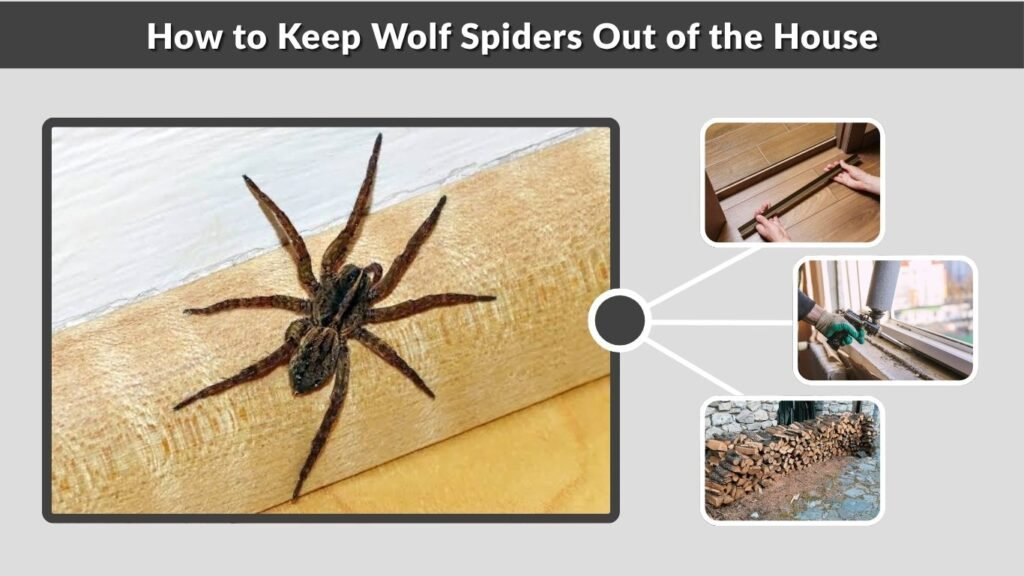
Long-term control should focus on limiting entry points and reducing the insects wolf spiders hunt.
Wolf Spider Prevention
Helpful steps include:
- Install door sweeps.
- Repair damaged window screens.
- Seal foundation cracks.
- Caulk gaps around pipes and cables.
- Reduce clutter in garages and basements.
- Keep firewood away from exterior walls.
- Trim vegetation touching the house.
- Reduce indoor insect populations.
- Vacuum along baseboards and hidden corners.
If many spiders appear repeatedly, investigate the underlying insect population.
Wolf Spider Infestation in the House
A large number of wolf spiders indoors is unusual, but repeated sightings can occur when environmental conditions are favorable.
The spiders may be entering from an outdoor population rather than reproducing throughout the house.
What to Do About Repeated Wolf Spiders
Start by inspecting:
- Basement windows
- Garage doors
- Foundation openings
- Crawl spaces
- Utility entrances
- Door thresholds
Then address insects such as crickets, cockroaches, flies, and other prey that may be attracting wolf spiders.
Professional pest control may be useful when repeated sightings continue despite exclusion and sanitation.
FAQs
Are Wolf Spiders Good to Have Around the House?
Wolf spiders are beneficial predators because they eat many insects. Outdoors, they are generally worth leaving alone. Indoors, you can safely relocate them if their presence makes you uncomfortable.
Why Do I Keep Finding Wolf Spiders in My House?
Repeated sightings may be caused by easy entry points, abundant insect prey, moisture, or seasonal movement. Seal cracks, install door sweeps, reduce indoor insects, and remove clutter to make the house less attractive.
Can Wolf Spiders Bite You While Sleeping?
Wolf spiders do not intentionally seek sleeping humans. A bite would be more likely if a spider became trapped between skin, clothing, or bedding and felt threatened. Such encounters are uncommon.
Is a Giant House Spider a Wolf Spider?
No. Giant house spiders and wolf spiders belong to different spider families. Giant house spiders are funnel weavers that may build webs, whereas wolf spiders generally hunt actively without using prey-catching webs.
What Should I Do If I Find a Wolf Spider in My House?
Avoid handling it directly. Cover the spider with a container, slide cardboard underneath, and release it outdoors. Then check doors, windows, foundations, and other potential entry points to reduce future encounters.
