
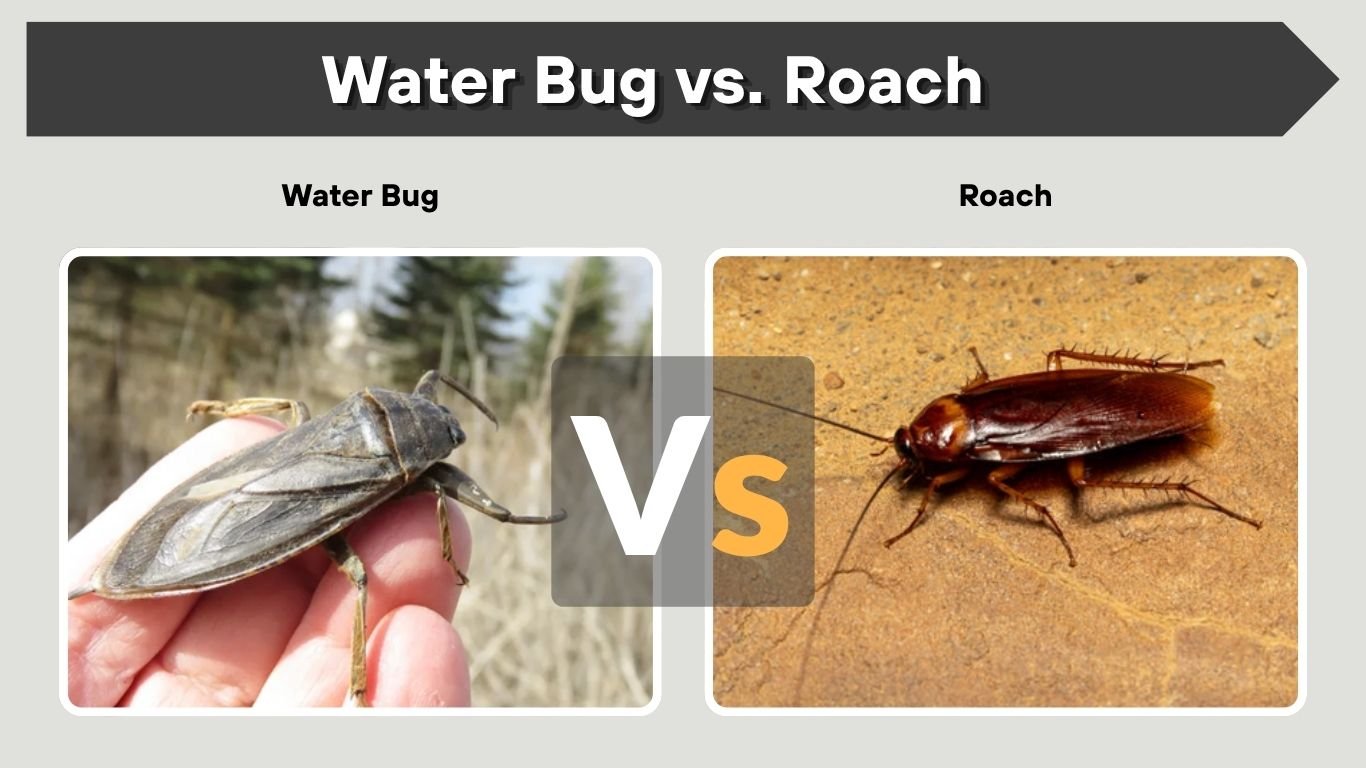
A large brown insect running across the bathroom floor is often called a water bug, but it may actually be a cockroach. True water bugs are aquatic insects that normally live in ponds and marshes, while roaches are land-dwelling insects that may reproduce inside buildings. The easiest ways to distinguish a water bug from a roach are to examine its antennae, front legs, body shape, movement and where it was found.
Are Water Bugs and Roaches the Same?
True water bugs and roaches are completely different insects. A true giant water bug belongs to the family Belostomatidae and spends most of its life in freshwater. It is a predatory insect equipped with powerful front legs for grabbing aquatic animals.
However, “water bug” is also a common nickname for American and Oriental cockroaches. These roaches are associated with drains, sewers, basements and other moist environments, which explains the confusing name. This usage is particularly common in cities such as New York.
Water Bug vs. Roach: Quick Comparison
A close look at the legs and antennae usually provides the fastest identification. True water bugs have short, partly hidden antennae and thick grabbing legs. Roaches have extremely long antennae and six spiny legs designed for running.
| Feature | True water bug | Roach |
| Insect group | Hemiptera | Blattodea |
| Typical habitat | Ponds, marshes and slow water | Buildings, sewers and outdoor debris |
| Body shape | Broad, flat and somewhat boat-shaped | Flat, oval and usually narrower |
| Antennae | Short and difficult to see | Very long and threadlike |
| Front legs | Thick, curved and pincer-like | Slender, spiny running legs |
| Hind legs | Flattened for swimming | Spiny and designed for running |
| Movement | Swims well; moves awkwardly on land | Runs rapidly across floors and walls |
| Indoor infestation | No | Yes, depending on species |
| Bite risk | Can deliver a painful defensive bite | Human bites are extremely uncommon |
| Diet | Aquatic animals | Food scraps and organic material |
What Does a True Water Bug Look Like?
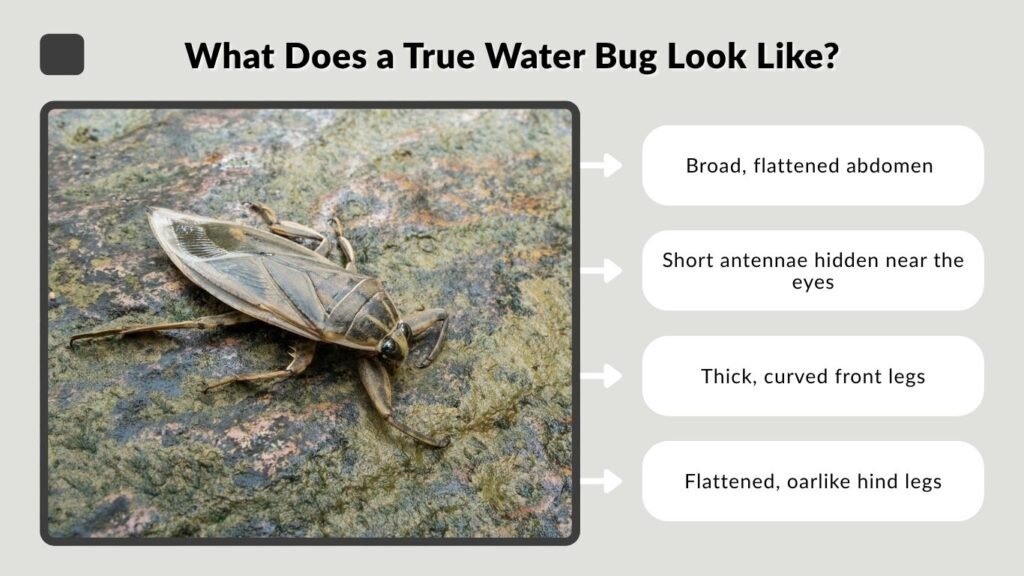
A true water bug usually has a wide, flattened body that may appear brown, tan, grayish brown or nearly black. Its shape resembles a dead leaf or an oval boat, helping it remain concealed among submerged vegetation.
Identification Features
- Broad, flattened abdomen
- Short antennae hidden near the eyes
- Thick, curved front legs
- Flattened, oarlike hind legs
- Wings folded across the back
- Short, pointed beak beneath the head
- Usually between one and two inches long in common North American species
Its muscular front legs are the most recognizable feature. These legs fold inward like pincers and hold fish, tadpoles, aquatic insects and other prey. Giant water bugs generally live in ponds, marshes, lakes and slow-moving streams rather than houses.
What Does a Roach Look Like?
A cockroach has a flattened, oval body with a shieldlike plate covering part of its head. Its antennae are generally as long as, or longer than, its body. The legs are narrow, covered in noticeable spines and built for rapid movement.
Roaches frequently run for shelter when lights are switched on. They hide in cracks, cabinets, drains, wall openings, appliance spaces and other protected locations. Correct identification is important because different cockroach species require different control strategies.
Common Roaches Called Water Bugs
| Common name | Appearance | Typical location |
| Oriental cockroach | Shiny dark brown or black; about one inch long | Basements, drains, crawl spaces and cool damp areas |
| American cockroach | Large and reddish brown with a pale marking behind the head | Sewers, boiler rooms, utility spaces and commercial buildings |
| German cockroach | Small, light brown and marked with two dark stripes | Kitchens, bathrooms and areas around appliances |
| Wood cockroach | Brown, slender and usually attracted from outdoors | Woodpiles, leaf litter and homes near wooded areas |
The Oriental cockroach is the species most consistently called a water bug because it strongly prefers cool, dark and damp locations.
Water Bug vs. Roach Size
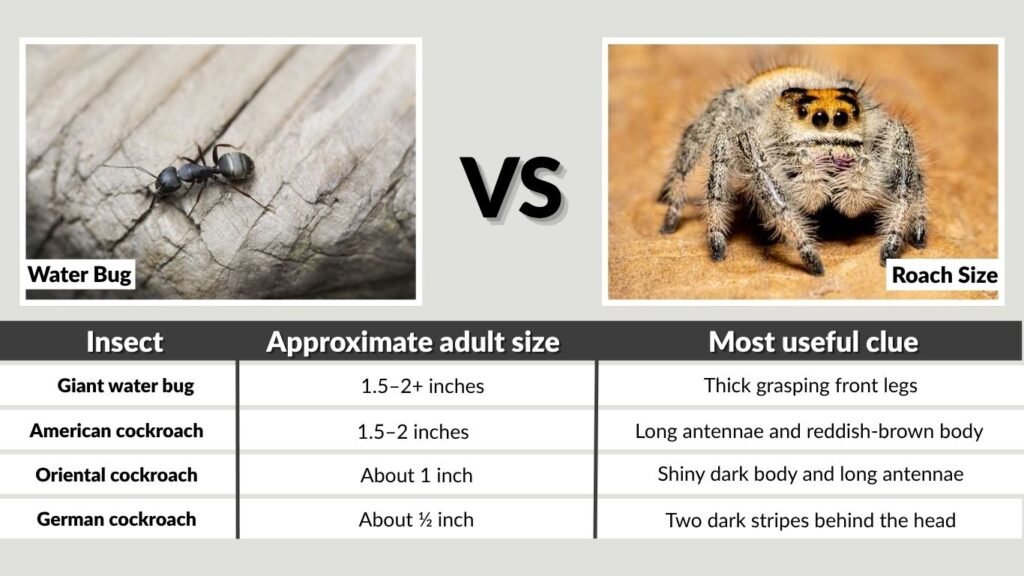
Size alone is not enough for identification because some roaches and true water bugs overlap considerably. A giant water bug is commonly around 1.5 to 2 inches long, although certain species in other regions can grow larger.
American cockroaches can approach two inches, making them easy to mistake for aquatic water bugs. Oriental cockroaches are generally about one inch long, while German cockroaches are considerably smaller.
| Insect | Approximate adult size | Most useful clue |
| Giant water bug | 1.5–2+ inches | Thick grasping front legs |
| American cockroach | 1.5–2 inches | Long antennae and reddish-brown body |
| Oriental cockroach | About 1 inch | Shiny dark body and long antennae |
| German cockroach | About ½ inch | Two dark stripes behind the head |
| Wood cockroach | ½–1 inch | Slender body and outdoor origin |
Baby Water Bug vs. Baby Roach
Both insects develop through incomplete metamorphosis, meaning their immature stages are called nymphs, not larvae. Nymphs resemble smaller versions of the adults but lack fully developed wings.
Baby Water Bug
A giant water bug nymph has a wide body, short antennae, powerful grabbing front legs and swimming-adapted hind legs. It normally occurs in water or along the edge of an aquatic habitat.
Baby Roach
A baby roach has long antennae, six spiny running legs and no developed wings. Its body may be lighter immediately after molting but soon darkens. Finding several small roaches in cabinets, kitchens or bathrooms strongly suggests that cockroaches are reproducing inside the building. German cockroaches are especially persistent indoor pests.
Giant Water Bug vs. Big Roach
A giant water bug may look like a large roach from above, but its front legs immediately separate it from a cockroach. The water bug’s front legs are thick and curved inward. A roach’s front legs resemble its other legs and are covered with small spines.
Their behavior is also different. Giant water bugs may fly toward exterior lights or accidentally land in swimming pools, driveways and patios. Roaches usually run along walls, hide under objects and repeatedly appear near food or moisture.
A single large insect beside a pool or porch light may be an accidental water bug. Multiple insects of different sizes inside a kitchen, basement or bathroom are much more likely to be roaches.
Water Bug vs. German Roach
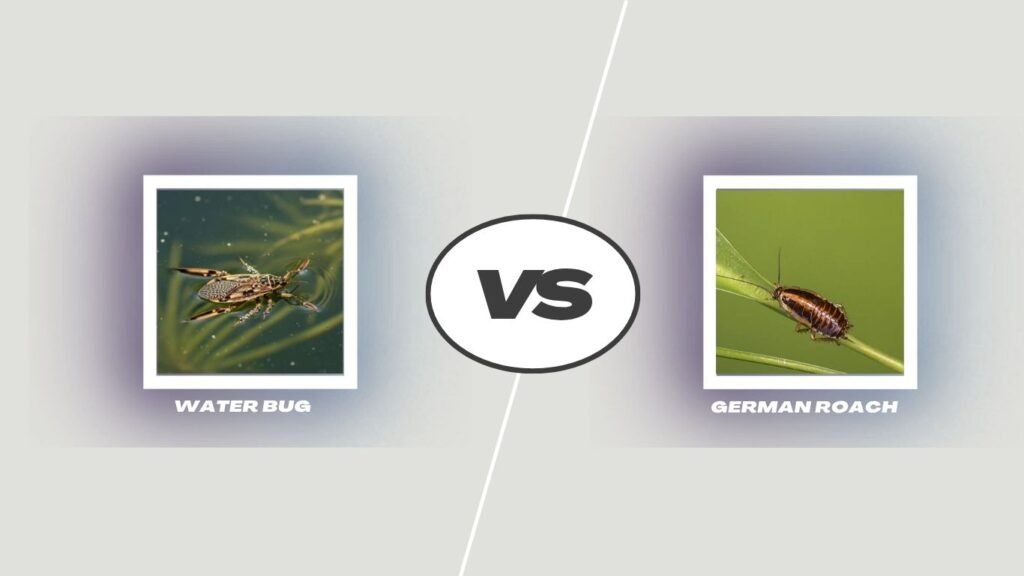
German roaches are much smaller than giant water bugs. Adults are light brown, approximately half an inch long and have two dark parallel stripes behind the head.
German roaches live almost entirely around human buildings and concentrate near kitchens and bathrooms. Seeing one during the daytime may indicate crowding or a substantial infestation. A true aquatic water bug will not establish a breeding population beneath a refrigerator or inside kitchen cabinets.
Water Bug vs. Wood Roach
Wood roaches live outdoors in leaf litter, firewood and decaying logs. They occasionally enter homes through doors or arrive with firewood, but they generally do not establish indoor infestations.
Unlike giant water bugs, wood roaches have long antennae and ordinary running legs. Unlike German or Oriental cockroaches, they are often encountered near wooded environments and may be active around lights. Penn State notes that wood cockroaches are primarily outdoor insects and accidental indoor visitors.
Do Water Bugs or Roaches Bite?
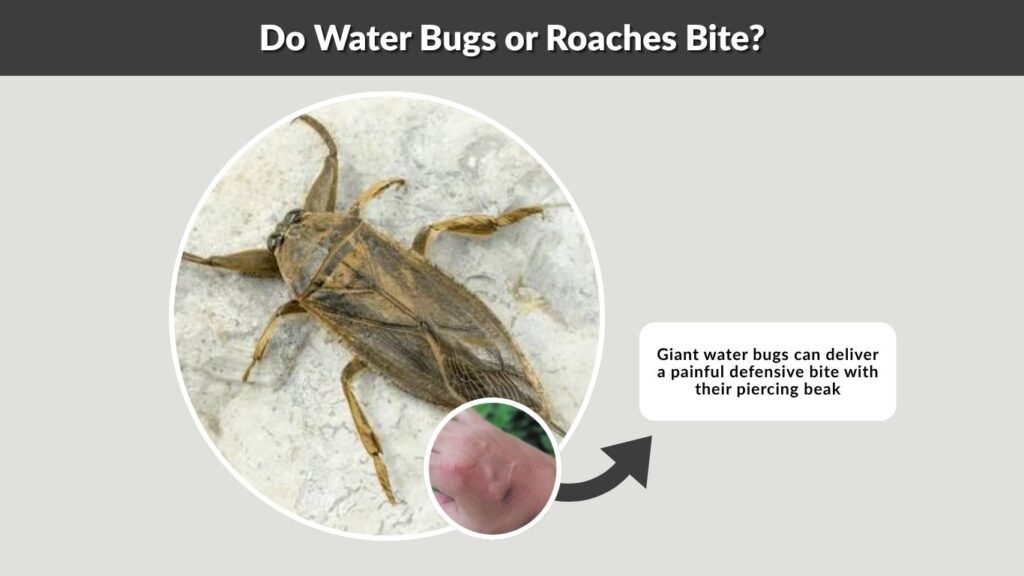
Giant water bugs can deliver a painful defensive bite with their piercing beak. Bites usually happen when someone handles the insect, steps near it while wading or traps it against the skin. They do not hunt humans or deliberately enter homes to bite people.
Cockroaches are not normally considered biting insects. The greater concern is an indoor population that contaminates food and surfaces and contributes allergens. Repeated sightings, droppings, egg cases and small nymphs should therefore be addressed promptly.
How to Tell What Is in Your House
Consider these four clues before attempting treatment:
- Check the antennae: Very long antennae indicate a roach. Short, hidden antennae suggest a true water bug.
- Examine the front legs: Thick, pincer-like legs identify a giant water bug.
- Consider the location: A bug near a pond, pool or outdoor light could be aquatic. Bugs inside cabinets or appliances are probably roaches.
- Count the sightings: One accidental visitor may be a water bug. Multiple adults and nymphs generally indicate cockroach activity.
What to Do After Identification
An isolated giant water bug can be captured with a container or long-handled net and released near an appropriate freshwater habitat. Avoid touching it directly because it can bite.
For cockroaches, remove food residue, repair leaks, reduce clutter, seal openings and place sticky monitoring traps beside walls and appliances. Properly positioned cockroach baits can help control established populations. Avoid relying only on sprays or foggers, which may fail to reach insects hiding inside cracks.
FAQs
Is a water bug just a big roach?
Not always. American and Oriental cockroaches are commonly nicknamed water bugs, but true water bugs are aquatic insects. Check the antennae and front legs: roaches have very long antennae, while giant water bugs have short antennae and thick grasping legs.
Which is bigger, a water bug or a roach?
Some giant water bugs are larger than common household roaches, but their size ranges overlap. Giant water bugs and American cockroaches can both approach two inches. Body structure, habitat and antenna length provide more reliable identification than size alone.
Why do people in NYC call roaches water bugs?
American and Oriental cockroaches are closely associated with sewer systems, drains and damp basements. Because these large roaches frequently emerge from moisture-rich locations, “water bug” became a common regional nickname even though they are not aquatic insects.
Does seeing one water bug mean an infestation?
One true aquatic water bug does not indicate an infestation because it cannot establish a colony in a normal house. One cockroach may be more concerning, especially when accompanied by droppings, egg cases, unpleasant odors or smaller nymphs.
Is a palmetto bug a water bug or a roach?
“Palmetto bug” commonly refers to a large cockroach, especially the American cockroach. It is not a true aquatic water bug. It has long antennae, spiny running legs and a reddish-brown body, and it may enter buildings from sewers or outdoor hiding places.
