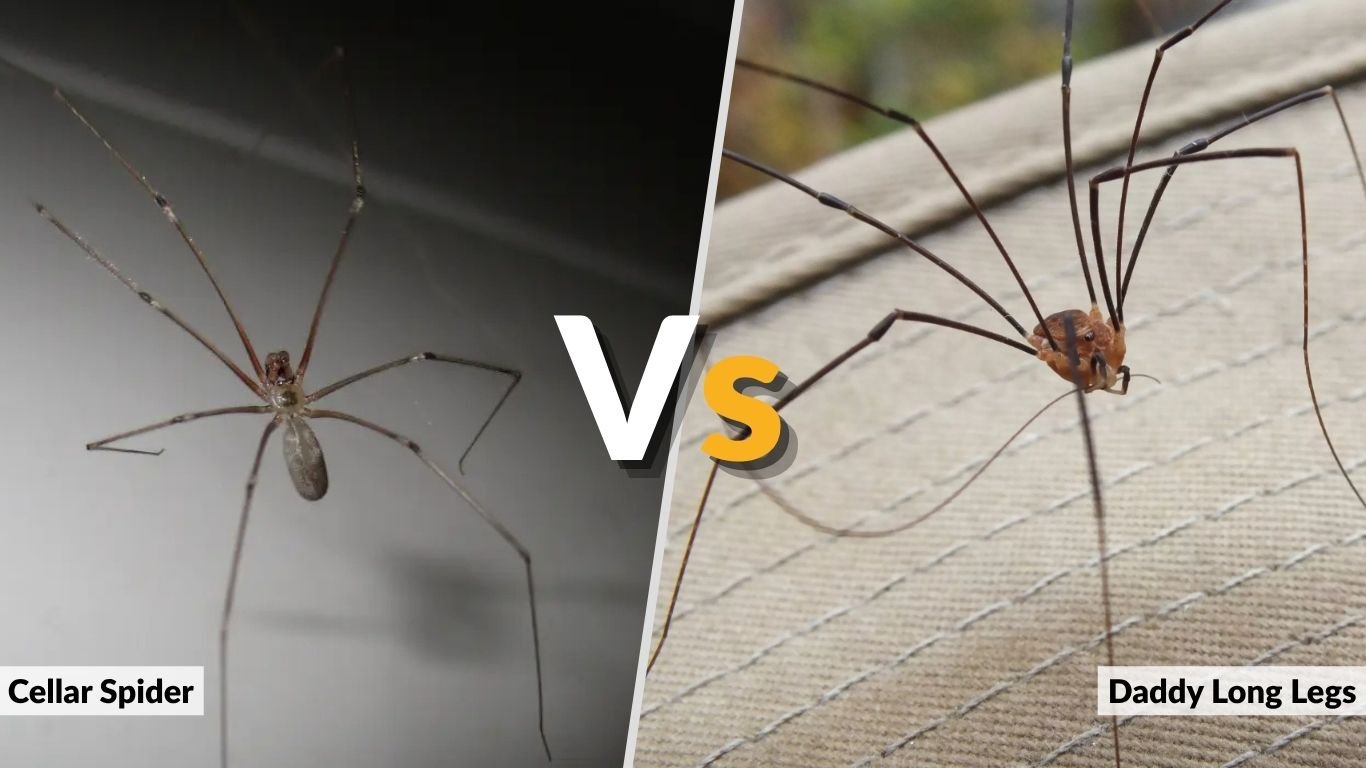
Cellar spiders and daddy long legs are often confused because both have very long, thin legs and are commonly seen around homes, gardens, basements, and dark corners. However, they are not always the same creature. In many places, “daddy long legs” is a common name used for different animals, including cellar spiders, harvestmen, and crane flies. Understanding the difference helps you identify them correctly and know whether they are harmless.
What Is a Cellar Spider?
A cellar spider is a true spider that belongs to the family Pholcidae. These spiders are often found in basements, cellars, garages, sheds, bathrooms, and quiet indoor corners. Their bodies are usually small and delicate, while their legs are extremely long and thin.
Cellar spiders are known for building messy, irregular webs. Unlike orb-weaving spiders that create neat circular webs, cellar spiders make loose, tangled webs in corners or under ceilings. They usually hang upside down in their webs and wait for small insects or other spiders to get trapped.
One common behavior of cellar spiders is vibrating rapidly when disturbed. If you touch their web or get too close, they may shake their body quickly. This movement can make them harder for predators to see and may help scare away threats.
Cellar spiders are harmless to humans. They do have venom because they use it to catch prey, but they are not considered dangerous. Their bites are rare and usually not medically important.
What Is a Daddy Long Legs?
The name “daddy long legs” can be confusing because it does not refer to only one animal. In different regions, people use this name for different long-legged creatures. Most commonly, it refers to harvestmen, which are arachnids but not true spiders. In some places, people also call cellar spiders daddy long legs.
Harvestmen belong to the order Opiliones. They have long legs like spiders, but their body structure is different. A harvestman usually has one rounded body section that looks like a small oval or ball. True spiders, including cellar spiders, have two main body parts: the cephalothorax and abdomen.
Another important difference is that harvestmen do not make silk webs. They do not have silk glands, so they cannot spin webs to catch prey. They also do not have venom glands like true spiders. This makes the common myth that daddy long legs are “the most venomous spider” completely false when referring to harvestmen.
Cellar Spider vs Daddy Long Legs: Quick Comparison
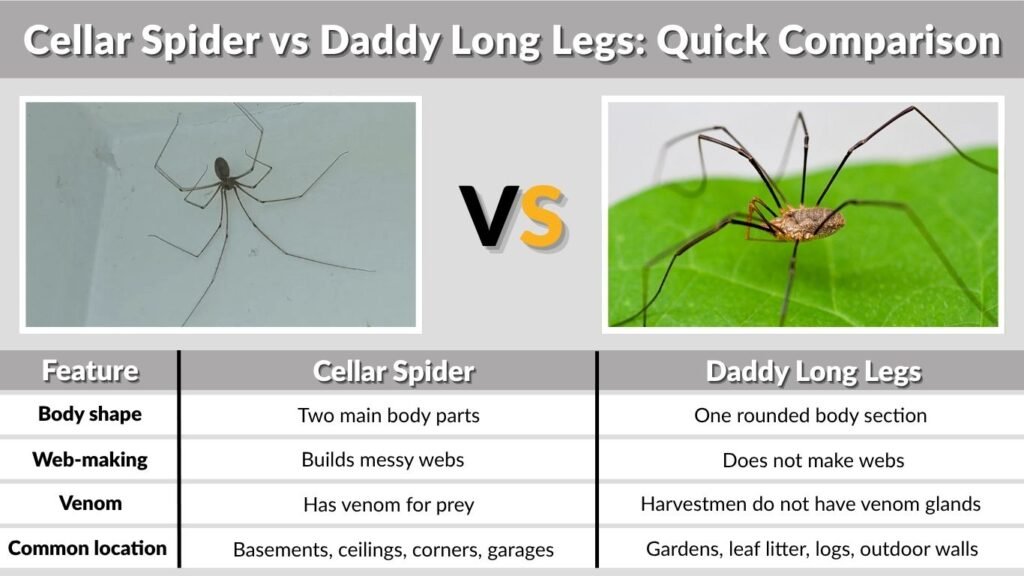
| Feature | Cellar Spider | Daddy Long Legs |
|---|---|---|
| Scientific group | True spider, family Pholcidae | Usually harvestman, order Opiliones |
| Body shape | Two main body parts | One rounded body section |
| Web-making | Builds messy webs | Does not make webs |
| Venom | Has venom for prey | Harvestmen do not have venom glands |
| Common location | Basements, ceilings, corners, garages | Gardens, leaf litter, logs, outdoor walls |
| Danger to humans | Harmless | Harmless |
Body Structure and Appearance
The biggest difference between cellar spiders and daddy long legs is body structure. A cellar spider has a small body divided into two visible sections. The front section holds the eyes, mouthparts, and legs, while the back section is the abdomen. This is the same basic body plan found in other true spiders.
Daddy long legs, when referring to harvestmen, look different. Their body appears as one single oval section. At first glance, this may seem like a tiny round body with very long legs attached to it. This simple body shape is one of the easiest ways to identify harvestmen.
Cellar spiders often look more fragile and web-based. You may see them hanging upside down in a web in a ceiling corner. Harvestmen are more often seen walking slowly across walls, soil, plants, or outdoor surfaces. They do not stay in webs because they do not make them.
Webs and Hunting Habits
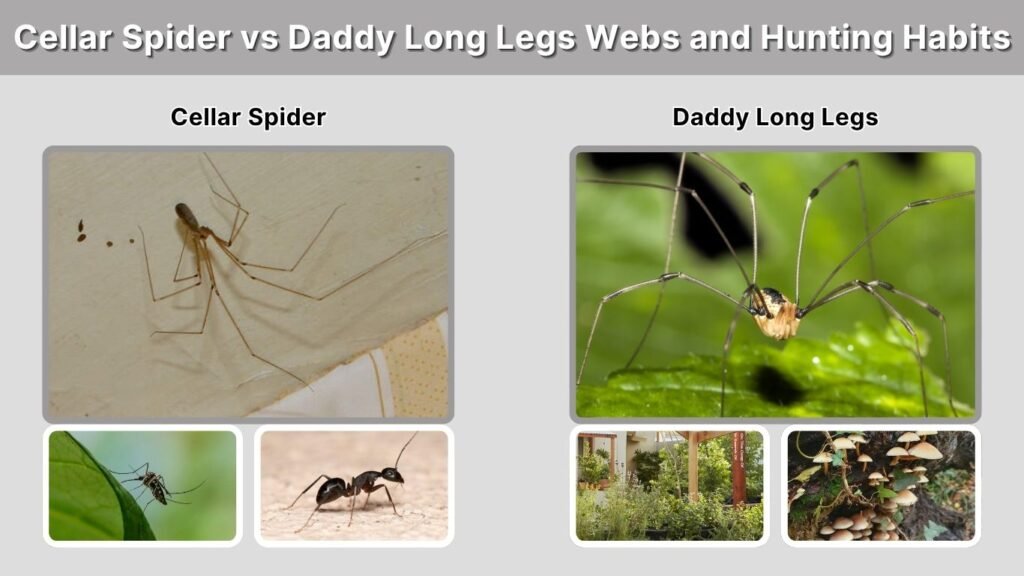
Cellar spiders rely heavily on webs. Their webs are messy and irregular, but they are effective traps for small insects. These spiders can catch flies, mosquitoes, moths, ants, and even other spiders. Because of this, many people consider them useful indoor pest controllers.
Daddy long legs, or harvestmen, do not use webs for hunting. Instead, they walk around searching for food. Their diet can include small insects, dead bugs, plant material, fungi, and decaying organic matter. They are more like scavengers and general feeders than classic web-building predators.
This difference in feeding style is very important. If the animal is sitting in a tangled web, it is most likely a cellar spider. If it is walking around outside with no web nearby, it may be a harvestman.
Key Identification Signs
| Identification Sign | What It Usually Means |
|---|---|
| Hanging upside down in a messy web | Cellar spider |
| Walking outdoors on soil, plants, or walls | Daddy long legs, usually harvestman |
| Body has two clear sections | Cellar spider |
| Body looks like one small rounded piece | Harvestman |
| Produces silk | Cellar spider |
| No web or silk production | Harvestman |
Are Cellar Spiders Dangerous?
Cellar spiders are not dangerous to humans. They may look unsettling because of their long legs and habit of hanging in corners, but they are not aggressive. They prefer to stay away from people and spend most of their time waiting in their webs.
There is a common myth that cellar spiders have extremely powerful venom but cannot bite humans because their fangs are too small. This is not accurate. Cellar spiders can bite small prey, but their venom is not known to be dangerous to people. Human bites are uncommon and usually cause little or no reaction.
In most homes, cellar spiders are more helpful than harmful. They catch small insects and may reduce the number of flies, mosquitoes, or other pests indoors.
Are Daddy Long Legs Dangerous?
Daddy long legs are also harmless. If the name refers to harvestmen, they do not have venom glands and cannot inject venom. They may release a defensive smell when threatened, but they are not dangerous to humans, pets, or buildings.
Harvestmen do not bite in the same way spiders do. Their mouthparts are not designed for attacking humans. They are mostly interested in tiny food sources and decaying material. Seeing them in a garden or near outdoor walls is usually not a cause for concern.
The idea that daddy long legs are deadly but unable to bite humans is a popular myth. It is not supported by their biology, especially when talking about harvestmen.
Habitat and Where You Find Them
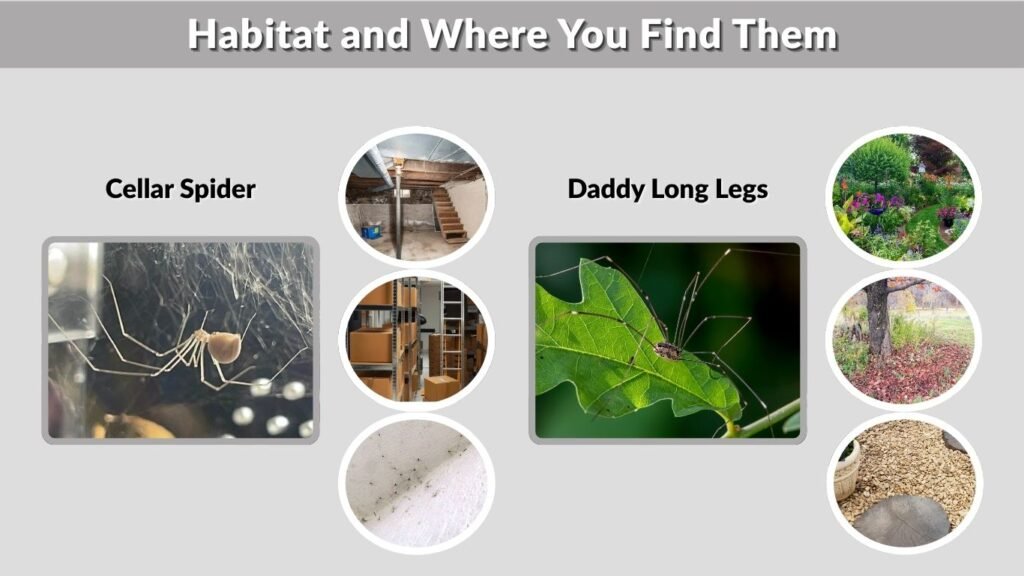
Cellar spiders are strongly associated with indoor and sheltered spaces. They like quiet places where their webs will not be disturbed. You may find them in:
- Basements and cellars
- Garages and storage rooms
- Bathroom corners
- Ceiling edges
- Under furniture
- Sheds and barns
Daddy long legs, especially harvestmen, are more common outdoors. They prefer damp, shaded environments where they can find food and shelter. You may notice them in:
- Gardens
- Leaf litter
- Under logs or stones
- Tree trunks
- Outdoor walls
- Moist grassy areas
However, harvestmen can sometimes enter homes by accident, especially during seasonal changes. They usually do not survive indoors for long unless conditions are suitable.
Main Differences in Simple Terms
The simplest way to understand the difference is this: a cellar spider is a real spider that builds webs, while a daddy long legs is often a harvestman that does not build webs. Both have long legs, both are harmless, and both are commonly misunderstood.
| Category | Cellar Spider | Daddy Long Legs |
|---|---|---|
| Is it a true spider? | Yes | Usually no, if it is a harvestman |
| Does it live in webs? | Yes | No |
| Does it help control pests? | Yes, catches insects in webs | Yes, may eat small insects and decaying matter |
| Should you remove it? | Only if webs bother you | Usually no need unless indoors |
| Best response | Leave it or gently relocate it | Leave it outside or gently move it out |
Which One Is Better to Have Around?
Both cellar spiders and daddy long legs can be beneficial. Cellar spiders help reduce indoor pests by trapping insects in their webs. They can be useful in basements, garages, and storage areas where flies or mosquitoes may appear.
Harvestmen also play a helpful role outdoors. They help clean up tiny dead insects and organic matter. In gardens, they are usually part of a healthy outdoor ecosystem and should not be treated as pests.
The only real downside of cellar spiders is their messy webbing. If you do not like webs in corners, you may want to clean them away and gently move the spider outside. Daddy long legs usually do not create mess because they do not spin webs.
How to Remove Them Safely
If you want to remove cellar spiders or daddy long legs from your home, avoid harsh chemicals. They are harmless and can be managed easily with simple methods.
For cellar spiders, use a cup and paper to gently capture and release them outside. You can also reduce their presence by regularly cleaning ceiling corners, removing old webs, and sealing gaps around windows or doors.
For daddy long legs, gently guide them outside if they enter your home. Since they usually prefer outdoor spaces, they often do not stay indoors for long. Keeping doors, windows, and cracks sealed can reduce accidental entry.
FAQs
Are cellar spiders the same as daddy long legs?
Sometimes, but not always. In some regions, people call cellar spiders daddy long legs because of their long, thin legs. However, the name daddy long legs often refers to harvestmen, which are arachnids but not true spiders. The best way to tell the difference is by checking for webs and body shape.
Do daddy long legs have venom?
Harvestmen, the animals most commonly called daddy long legs, do not have venom glands. This means they cannot inject venom into humans or prey. Cellar spiders do have venom because they are true spiders, but their venom is used for small prey and is not considered dangerous to people.
Why do cellar spiders shake in their webs?
Cellar spiders often shake or vibrate rapidly when disturbed. This behavior may help confuse predators or make the spider harder to see clearly. It can look strange, but it is a defensive reaction. The spider is usually trying to avoid danger rather than attack.
Should I kill cellar spiders in my house?
There is usually no need to kill cellar spiders. They are harmless and can help control small insects indoors. If their webs bother you, you can clean the area and gently move the spider outside. Regular cleaning and sealing entry points can help reduce their numbers naturally.
How can I quickly identify a harvestman?
A harvestman usually has one small, rounded body section and very long legs. It does not sit in a web and is often found walking outdoors in gardens, leaf litter, or damp shaded areas. If the creature has no web and looks like a tiny oval body on long legs, it is likely a harvestman.